
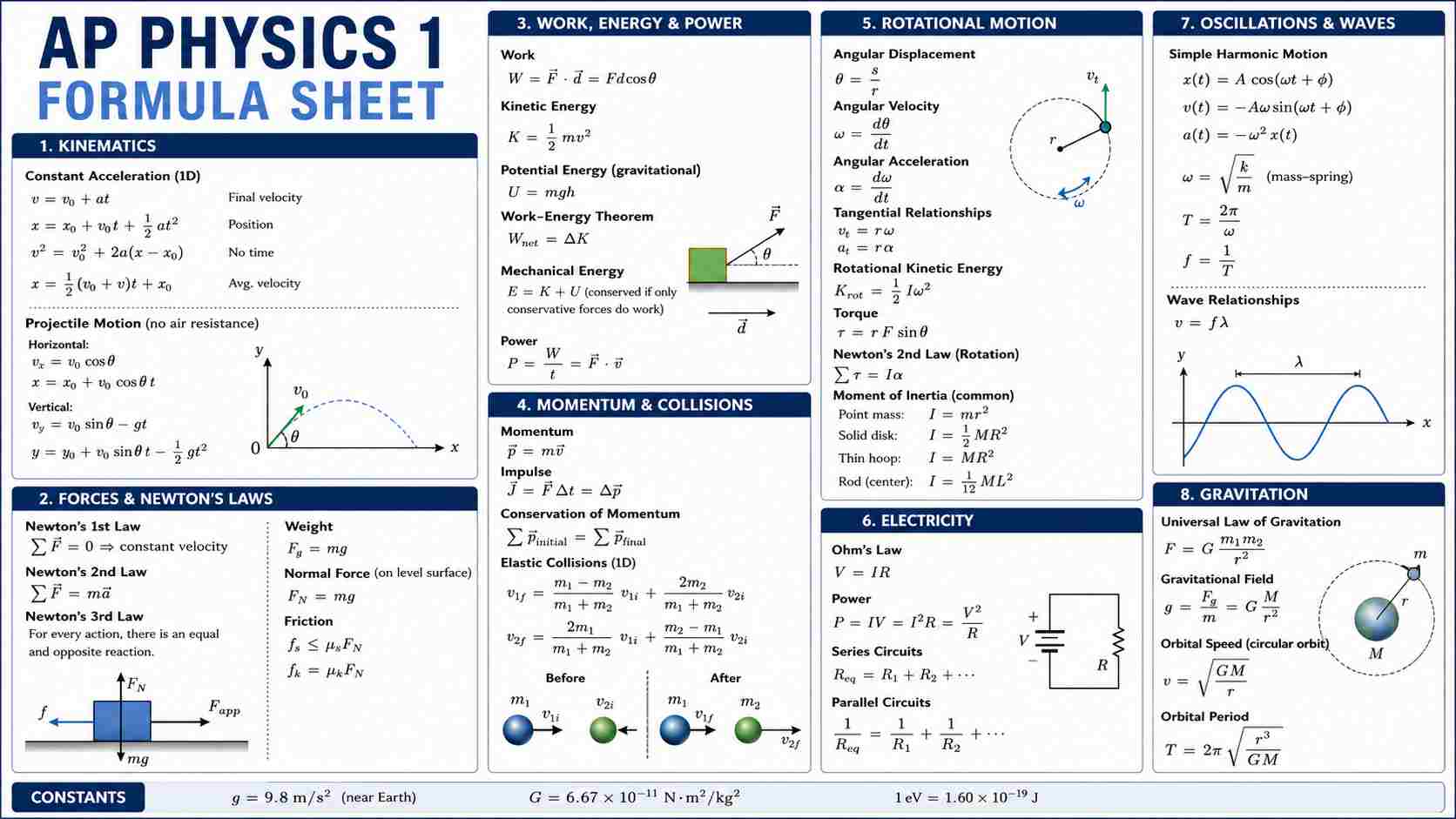
Introduction
The AP Physics 1 Formula Sheet is one of the most useful tools for students preparing for the AP Physics 1 exam. It contains many important equations that help you solve physics problems during the test. Instead of trying to remember every formula, you can use the formula sheet and focus on understanding how and when to apply each equation.
Many students think that having the formula sheet means the exam will be easy. However, success in AP Physics 1 depends more on understanding physics concepts than simply knowing formulas. You need to know what each equation means, what the symbols represent, and which formula fits a specific question.
This guide explains everything about the AP Physics 1 Formula Sheet in easy English. You will learn what the formula sheet includes, when you can use it, important formulas, study tips, common mistakes, and more. Whether you are starting your AP Physics course or getting ready for exam day, this guide will help you study with confidence.
What Is the AP Physics 1 Formula Sheet?
The AP Physics 1 Formula Sheet is an official reference sheet provided for students taking the AP Physics 1 exam. It contains many of the equations and constants needed to solve physics questions. The formula sheet is created by the College Board, the organization that manages AP exams.
Its main purpose is to reduce the need to memorize every equation. Instead, students can spend more time learning physics concepts, solving problems, and understanding how different formulas work together.
The formula sheet is mainly used during the AP Physics 1 exam, but it is also a great study tool throughout the school year. Many teachers encourage students to practice with the same sheet they will receive during the exam. This helps students become familiar with its layout and quickly find the formulas they need.
Although many important equations are included, not every relationship is written on the sheet. Students still need to understand concepts such as force, energy, momentum, motion, and graphs. The formula sheet supports your learning, but it does not replace careful study and regular practice.
Does the AP Physics 1 Exam Provide a Formula Sheet?
Yes. Every student taking the AP Physics 1 exam receives the official formula sheet. Whether you take the exam on paper or in the approved digital format, the necessary reference information is provided as part of the exam materials. You do not need to memorize every equation before test day.
Students are not allowed to bring their own printed formula sheet into the exam room. The College Board provides the official version to make sure everyone has the same reference.
The formula sheet includes many useful equations, symbols, and physical constants that are needed for the exam. It covers topics such as motion, forces, energy, momentum, rotation, waves, electricity, and circuits.
However, the formula sheet does not explain how to solve each problem. It also does not tell you which equation to choose. That is why understanding physics concepts is still very important. During the exam, you must read each question carefully, identify the correct formula, and apply it correctly.
The best way to prepare is to practice with the official formula sheet while solving sample questions. This helps you save time and feel more confident during the real exam.
What’s Included in the AP Physics 1 Formula Sheet?
The AP Physics 1 Formula Sheet is divided into different sections based on the topics covered in the course. This organized layout makes it easier to find the equation you need during the exam.
The first section focuses on mechanics, including formulas for velocity, acceleration, motion, force, and Newton’s Laws. These are some of the most commonly used equations in AP Physics 1.
Another section covers energy and work. Here you will find equations for kinetic energy, gravitational potential energy, work done by a force, mechanical energy, and power. These formulas help explain how energy changes from one form to another.
The formula sheet also includes momentum and impulse equations. These are important for studying collisions and the conservation of momentum.
You will also find formulas for rotational motion, simple harmonic motion, and waves. These topics include equations for torque, angular speed, frequency, period, and wave speed.
Finally, the sheet contains formulas for electricity and basic circuits, along with important physical constants and SI units. Knowing where each section is located will help you find formulas quickly during the exam and use your time more effectively.
AP Physics 1 Formula Sheet (Complete List of Formulas)
The AP Physics 1 Formula Sheet includes many important equations. These formulas help you solve questions in different topics. The table below explains the most common formulas, what they mean, and when to use them.
Kinematics Formulas
Kinematics is the study of motion. These formulas describe how objects move without looking at the forces causing the motion.
| Formula | Meaning | Variables | When to Use | Example |
| v = d/t | Velocity | v = velocity, d = distance, t = time | Find speed of an object | A car travels 100 m in 5 s |
| vavg = Δx/Δt | Average Velocity | Δx = change in position | Average motion | Motion over a period of time |
| a = Δv/Δt | Acceleration | a = acceleration | Find change in velocity | Speed increases every second |
| vf = vi + at | Final Velocity | vi = initial velocity | Constant acceleration | Falling objects |
| Δx = vit + ½at² | Position | Δx = displacement | Find distance traveled | Motion from rest |
Always check what the question asks before choosing a formula. Look at the given values and match them with the correct equation.
Newton’s Laws Formulas
Newton’s Laws explain why objects move or stay still. These equations are used in many AP Physics 1 questions.
| Formula | Meaning | Common Use |
| F = ma | Force | Find force, mass, or acceleration |
| W = mg | Weight | Calculate weight using gravity |
| ΣF = ma | Net Force | Find total force on an object |
| Ff = μN | Friction | Calculate friction between surfaces |
| N | Normal Force | Support force from a surface |
| T | Tension | Force in a rope or cable |
For example, if a box with a mass of 5 kg accelerates at 2 m/s², the force is F = 5 × 2 = 10 N.Understanding the direction of each force is just as important as knowing the formula.
Circular Motion Formulas
Circular motion happens when an object moves in a circle.
| Formula | Meaning |
| Fc = mv²/r | Centripetal Force |
| ac = v²/r | Centripetal Acceleration |
| ω = θ/t | Angular Speed |
| v = rω | Tangential Speed |
These equations are often used for cars turning on roads, spinning wheels, or planets moving in orbit.
Work, Energy, and Power Formulas
Energy is one of the most important topics in AP Physics 1.
| Formula | Meaning |
| W = Fd cos θ | Work Done |
| KE = ½mv² | Kinetic Energy |
| PE = mgh | Gravitational Potential Energy |
| ME = KE + PE | Mechanical Energy |
| P = W/t | Power |
| Efficiency = Useful Output/Input × 100% | Efficiency |
Use these formulas whenever the question involves moving objects, lifting objects, or machines doing work.
Momentum Formulas
Momentum explains how moving objects behave during collisions.
| Formula | Meaning |
| p = mv | Momentum |
| J = FΔt = Δp | Impulse |
| m₁v₁ + m₂v₂ = m₁v₁’ + m₂v₂’ | Conservation of Momentum |
These equations are useful for car crashes, sports, and collision problems.
Rotational Motion Formulas
Rotational motion deals with spinning objects.
| Formula | Meaning |
| τ = rF sin θ | Torque |
| α = Δω/Δt | Angular Acceleration |
| I | Moment of Inertia |
| KErot = ½Iω² | Rotational Kinetic Energy |
These formulas help solve questions about rotating wheels, gears and disks.
Oscillation and Simple Harmonic Motion
Some objects move back and forth in a repeating pattern.
| Formula | Meaning |
| T = 1/f | Period |
| f = 1/T | Frequency |
| ω = 2πf | Angular Frequency |
| Fs = -kx | Spring Force |
| T = 2π√(L/g) | Simple Pendulum |
These formulas are used for springs and pendulums.
Waves Formulas
Wave questions appear regularly on the AP Physics 1 exam.
| Formula | Meaning |
| v = fλ | Wave Speed |
| f = 1/T | Frequency |
| λ = v/f | Wavelength |
| T = 1/f | Period |
Knowing the relationship between wave speed, wavelength, and frequency helps solve many problems quickly.
Electricity and Circuits Formulas
Basic electricity is also included on the formula sheet.
| Formula | Meaning |
| I = Q/t | Electric Current |
| V = IR | Ohm’s Law |
| R = V/I | Resistance |
| P = IV | Electrical Power |
| F = kq₁q₂/r² | Coulomb’s Law (reference only) |
These equations are useful when solving circuit questions involving batteries, resistors, and electric current.
AP Physics 1 Constants on the Formula Sheet
The formula sheet also provides several important physical constants. These values save time because you do not need to memorize them.Some common constants include:
| Constant | Symbol | Value |
| Gravitational Acceleration | g | 9.8 m/s² |
| Speed of Light | c | 3.0 × 10⁸ m/s |
| Elementary Charge | e | 1.60 × 10⁻¹⁹ C |
| Pi | π | 3.14159 |
The sheet also uses standard SI units such as meters (m), kilograms (kg), seconds (s), newtons (N), joules (J), watts (W), volts (V), and amperes (A). Learning these units helps you understand each equation and avoid mistakes during calculations.
Variables and Symbols Explained
Physics uses symbols to make equations shorter and easier to read. Understanding these symbols is very important.
| Symbol | Meaning | SI Unit | Common Use |
| v | Velocity | m/s | Motion |
| a | Acceleration | m/s² | Motion |
| F | Force | N | Newton’s Laws |
| m | Mass | kg | Mechanics |
| P | Power | W | Energy |
| W | Work | J | Energy |
| KE | Kinetic Energy | J | Moving objects |
| PE | Potential Energy | J | Stored energy |
| I | Current | A | Circuits |
| V | Voltage | V | Electricity |
| R | Resistance | Ω | Circuits |
| t | Time | s | Motion |
| d | Distance | m | Kinematics |
| θ | Angle | Degrees/Radians | Rotation |
| ω | Angular Speed | rad/s | Circular Motion |
| α | Angular Acceleration | rad/s² | Rotational Motion |
Before solving any question, identify what each symbol means. This simple habit makes it much easier to choose the correct formula and solve problems accurately.
How to Read the AP Physics 1 Formula Sheet?
The AP Physics 1 Formula Sheet is easy to use if you know where to look. Before the exam, spend time reading the sheet and learning how it is organized. This will help you find formulas quickly and save valuable time during the test.
Start by reading the question carefully. Find out what information is given and what you need to calculate. Then look for the section on the formula sheet that matches the topic, such as motion, energy, momentum, or electricity.
Next, check the symbols in the formula. Make sure you understand what each variable means. For example, v stands for velocity, while a means acceleration. Mixing these symbols can lead to wrong answers.
Always use the correct SI units. If the values are given in centimeters or grams, convert them to meters or kilograms before using the formula. This simple step helps prevent calculation errors.
Sometimes you may need to rearrange an equation to find the missing value. Practice solving formulas for different variables before the exam. After you finish your calculation, check whether your answer is reasonable and whether the unit is correct. These habits will help you solve problems with greater confidence.
When Should You Use Each Formula?
Knowing a formula is helpful, but knowing when to use it is even more important. Every physics question gives clues about which equation you need.If the question asks about speed, distance, time, or acceleration, use the kinematics formulas. These equations describe how objects move.If the problem talks about forces acting on an object, use Newton’s Laws. For example, if you need to find the force that causes an object to accelerate, use F = ma.
When a question involves energy changing from one form to another, use work and energy equations. If an object falls from a height, gravitational potential energy changes into kinetic energy.
If two objects collide, use the momentum formulas. In many collision problems, the total momentum before the collision equals the total momentum after the collision.Use rotational motion formulas when an object spins around a point. Wheels, gears, and rotating disks are common examples.
For springs, pendulums, and repeating motion, use simple harmonic motion formulas. For wave questions, use the wave speed equation v = fλ.The more practice questions you solve, the easier it becomes to choose the correct formula without wasting time.
Formulas You Still Need to Know Even with the Formula Sheet
Even though the exam provides the AP Physics 1 Formula Sheet, you cannot depend on it alone. The formula sheet gives equations, but it does not explain how or why they work.You should understand the ideas behind each formula. For example, knowing that force equals mass times acceleration is useful, but you should also understand how increasing mass or acceleration changes the force.You should also know how to read graphs. Position-time, velocity-time, and force graphs appear often on the AP Physics 1 exam. The formula sheet does not explain how to interpret these graphs.
Another important skill is equation manipulation. Sometimes you need to rearrange a formula before solving a problem. Practicing algebra will make this much easier.You should also understand relationships between different physics concepts. For example, energy, force, and motion are connected in many questions. If you understand these connections, you will solve problems more quickly.
Finally, always remember your SI units. Correct units help you check your answers and avoid simple mistakes.
AP Physics 1 Formula Sheet vs AP Physics C Formula Sheet
Although both exams provide formula sheets, they are designed for different courses.
| Feature | AP Physics 1 | AP Physics C |
| Math Level | Algebra-Based | Calculus-Based |
| Main Topics | Mechanics, Waves, Electricity | Mechanics and Electricity with Calculus |
| Difficulty | Moderate | Higher |
| Calculus Required | No | Yes |
| Best For | High school beginners | Advanced physics students |
The AP Physics 1 Formula Sheet focuses on algebra-based equations. It is perfect for students taking their first college-level physics course.The AP Physics C Formula Sheet includes many calculus-based equations and more advanced topics. Students in AP Physics C need a stronger math background because they use derivatives and integrals to solve problems.If you are taking AP Physics 1, do not worry about the AP Physics C formulas. Focus on learning the equations included in your own course and practice using them correctly.
Common Mistakes Students Make When Using the Formula Sheet
Many students lose easy marks because of small mistakes, not because they do not know physics.One common mistake is choosing the wrong formula. Before solving, always ask yourself what the question is really asking. Read carefully instead of selecting the first equation you see.
Another mistake is forgetting to convert units. If the question gives centimeters, convert them to meters before using the formula. The same rule applies to grams, kilometers, and other units.Students also mix up similar symbols. Velocity and acceleration are different, even though both describe motion. Pay close attention to the variables.Ignoring direction is another common error. Many physics quantities are vectors, which means direction matters. Positive and negative signs can change the final answer.Some students also forget to check their calculations. A quick review at the end can help you catch typing errors, wrong units, or incorrect decimal places.Avoiding these simple mistakes can improve your exam score without learning any new formulas.
How to Memorize AP Physics 1 Formulas Faster?
Although the formula sheet is provided during the exam, learning the most common equations makes problem-solving much faster.
Start by grouping formulas into topics such as motion, forces, energy, and electricity. Studying similar equations together makes them easier to remember.Create flashcards with the formula on one side and its meaning on the other. Review them for a few minutes every day instead of studying everything at once.
Practice solving real physics problems. Using formulas again and again helps your brain remember them naturally. This is much more effective than reading equations without practice.Another helpful method is active recall. Close your notebook and try to write the formulas from memory. Then check your answers and correct any mistakes.
You can also draw simple concept maps that connect related topics. For example, show how force causes acceleration or how potential energy changes into kinetic energy.Daily practice is the best way to build confidence. Even spending 15 to 20 minutes each day reviewing formulas and solving questions can make a big difference before the AP Physics 1 exam.
Best Study Tips for the AP Physics 1 Exam
Preparing for the AP Physics 1 exam takes more than reading the AP Physics 1 Formula Sheet. You should understand the ideas behind the formulas and practice using them in different questions.
Start your preparation early. Study a little every day instead of trying to learn everything in one week. This helps you remember concepts for a longer time.Practice with past AP exam questions whenever possible. These questions show you the style and difficulty of the real exam. They also help you learn how to manage your time.
Spend time on both multiple-choice questions (MCQs) and free-response questions (FRQs). The two sections test different skills, so practicing both is important.Use your calculator correctly and check your answers before moving to the next question. If you make a mistake, review it and understand why it happened.
Finally, use the official AP Physics 1 Formula Sheet while studying. The more familiar you are with it, the faster you will find formulas during the exam.
Printable AP Physics 1 Formula Sheet PDF
Many students like to print the AP Physics 1 Formula Sheet before the exam. A printed copy makes studying easier because you can highlight important formulas and write notes beside them.
Keep the formula sheet with your class notes or practice questions. Every time you solve a problem, try finding the formula from the sheet instead of memorizing its location. This builds confidence and improves your speed.You can also place the printed sheet in a folder or laminate it to keep it clean during your study sessions. Some students prefer saving a PDF copy on their laptop or tablet so they can study anywhere.
Remember that the official formula sheet used in the exam is provided by the College Board. Always practice with the latest version so you become familiar with the same layout you will see on test day.Using a printable PDF regularly helps you understand the formulas instead of simply reading them.
Best Resources for AP Physics 1 Formula Practice
There are many resources that can help you master the AP Physics 1 Formula Sheet.The official College Board website should be your first choice. It offers course information, sample questions, and exam materials that match the real AP exam.
Many students also use AP Physics review books because they include clear explanations, worked examples, and practice tests. These books help you apply formulas in real exam situations.Online learning websites provide free quizzes and practice problems. Video lessons are also useful because teachers explain difficult topics step by step.
Flashcards are another great study tool. They help you remember symbols, units, and equations through regular review.Finally, ask your teacher for extra worksheets or classroom notes. Practicing different types of questions will improve both your understanding and your confidence before exam day.
Frequently Asked Questions
1. Is the AP Physics 1 Formula Sheet enough to pass the exam?
No. The formula sheet is a helpful reference, but you must also understand physics concepts and practice solving problems.
2. Should I memorize formulas if they are provided?
Yes. Knowing the most common formulas makes solving questions much faster and gives you more confidence during the exam.
3. Can I use an old AP Physics 1 Formula Sheet for practice?
It is better to use the newest official version so that it matches the formula sheet provided during your exam.
4. Which topic uses the most formulas in AP Physics 1?
Mechanics usually includes the largest number of formulas because it covers motion, forces, energy, and momentum.
5. How often should I practice with the formula sheet?
Try to use it every time you solve physics questions. Daily practice will help you become familiar with the formulas and their locations.
Conclusion
The AP Physics 1 Formula Sheet is one of the most valuable resources for students preparing for the AP Physics 1 exam. It provides important equations for motion, forces, energy, momentum, waves, rotation, and electricity. However, simply having the formula sheet is not enough. You must understand what each formula means and know when to use it.Practice with the official formula sheet as often as possible. Solve different types of questions, review your mistakes, and build a strong understanding of physics concepts. With regular practice and smart preparation, you will be ready to use the AP Physics 1 Formula Sheet confidently and perform your best on exam day.
 anasshahzad